Archive for category thoughts
Become an organ donor today
It’s Easter, a time in which we remember how Jesus gave his body for our salvation. Donating your organs when you die seems to me to be a suitable way to honour this supreme sacrifice.
I have always been in favour of organ donation, but until now nothing has gotten me to officially register as an organ donor. I just found out, however, that my mother is going to get a donor cornea, something we had been hoping for.
My family has known for a long time that I would like to be an organ donor. However, it has taken news of this good fortune for me to seek out official registration. This was rather silly of me. Registration takes 2 minutes. South Africans go to the organ donor foundation and Dutchies, you can go to the JaofNee campaign.
Register as an organ donor. It costs you nothing and it ensures that, should you die, there is no question of what to do with your body. Do it now.
Society at the end of the rainbow
Posted by johandp in Christianity, thoughts on 30/03/2013
Gay marriage is in the news again, this time because it is being debated in American courts once again. I for one cannot understand how bans on gay marriage have continued so long. In a court of law you can swear on the Bible, but you can’t use it to prove your case.
Support for Gay marriage has been rising, especially among the young. At the same time religion has been waning. There are, of course, many Christians who approve of gay marriage. There are very few, probably, who think that the issue of legality of gay marriage is entirely distinct from the issue of whether it is sinful.
I wonder what will happen. I think support for gay marriage will only grow. We are speedily heading to the end of a gay rainbow. Opponents of gay marriage are on the defensive, and that includes conservative Christians. To the “enlightened” they must seem like some cartoon villain, refusing to give up when the battle is already over. This The Oatmeal comic shows exactly what is happening.
Either the church will change to embrace gay marriage or the next generations will leave the church. Perhaps they’ll establish their own gay-friendly churches. Or perhaps Christianity will be discarded altogether.
I love the Church. I do not wish for it to be displaced. But I fear church intransigence, particularly that of the Catholic church, will drive the decline of faith in coming years. That would be alright, if it were in the name of a truly noble cause. If it were like driving money-changers from the temple. But who is the villain in this story? The myriad of gays asking for their love to be recognized?
Drawing from another Biblical reference: the writing is on the wall. The writing this week took the form of the following picture, used as a profile picture by supporters of gay marriage. It’s message is simple, appealing: Equality. It’s not going away.

Marriage: the scariest, most beautiful thing
I’m getting to that age, that age where your friends start pairing off into couples and becoming married. Do not worry, this post is not about how mortified I am that I am still single and how there’s no end in sight. Instead I want to say something about the incredible commitment that marriage is.
I can think of nothing more beautiful and more terrifying than marriage. If you’re a Christian, then, in theory at least, marriage is for life. The certainty you must have to make that commitment… I think I might have to wait till I’m a hundred before I am that certain about anything (except death and taxes).
Marriages do not always last. When you enter into one, you must (even if you are a Christian) be aware that it may end prematurely. That does not mean you should not try. And marriages that do not end in divorce, end in death. There must be no greater grief (except the loss of a child) than the loss of your life partner. If you’re a woman that is most likely what you will experience (women live longer and marry younger), but men are not exempt of course.
Still, a life shared is a beautiful thing. I am thinking beyond the wedding and the honeymoon. It is in every day’s living, in the little joys, in the dull, the dreary, in toil, strife and hardship, that a marriage is built. It is in saying “I love you” every day, to mean it even if you’re in the middle of a heated argument.
Marriage is not a cure for a lonely life. It does not make a broken person complete. But it does, sometimes, make of two people, a single being, inseparable, a force of joy and love and an inspiration to all. It is truly a gift from God (one that like a plant must be nurtured if it is to last). I hope that all my friends who are married and soon to be married (and those who will marry later) experience this gift.
I wrote this poem for you:
Love is grand – it deserves a festival
and a honeymoon
and a yearly anniversary
romantic dinners and flowers and gifts
perfume and makeup

Love starts with a beating heart
and sweaty palms
with grandiose gestures
but it is in everyday things
that love is made complete
in two lives that become
in  every day’s living
a life shared
in little joys
in leaving for work
in weekday dinners
in the love (or hate) of football
in the dull, the dreary
in shopping
in the choice of asymmetric carpets and paint
in toil, strife and hardship
in paying the bills
together

Love is quiet and unrelenting
its strength is the strength of God
its weakness is the weakness of man
love matures with its hosts
becomes the finer for their wrinkles
and frailty

Love is a gift from God
Dutch Capitalism – not always very capitalistic
A Chinese colleague of mine once claimed that Maoism (a form of communism) is better implemented in the Netherlands than China. I don’t know enough about Maoism to be able to argue for or against this, but sometimes the Dutch system of capitalism is very anti-capitalistic. Take, for instance, a practice known as “koopzondagen”.
These are Sundays on which shops open for business. Until recently I just thought shops chose to be closed on Sundays, except for the koopzondagen. In Amsterdam this appears to be the case. But it is not so in the rest of the country. Local governments (or municipalities – I am not sure which) have the power to regulate whether shops can open on Sundays or not. Thus it is that in Tilburg there have been shops opening on Sundays despite this not being allowed (after some debate it has been decided to allow them to open).
I could hardly believe it when I heard this. Why would you not allow shops to open on Sundays? If you are of certain (dogmatic) religious bent you could argue that it respects the Sabbath. But Dutch people are not. Perhaps it is a legacy of the Dutch religious past that they have not done away with yet.
A country that values the freedoms of its people and its economy (as the Dutch do) cannot allow such a nonsensical system to continue. There are many consumers that would like to shop on Sundays, many shops that would like the freedom to open on Sundays and many people willing to work on Sundays. Everybody benefits. Many shops may choose to stay closed on Sundays and this is fine. But it should be their choice.
The right to beg: a third world perspective
(Disclaimer: this was written based entirely on my own personal experience. If I have any facts wrong, please let me know. )
I recently read in a Dutch newspaper that there are 253 registered beggars in Amsterdam. Several things about this statement shocked me.
253 is ridiculously little. I don’t think any city in South Africa has so few beggars, even as a percentage of population (though I have not checked the figures –there may not even be any figures).
The fact that beggars are registered and that begging is in fact outlawed (except, I suppose for these registered beggars) seems almost monstrous when you come from a country where almost every traffic light in every major city has children below the age of ten asking you for some coins. To deny so many people this form of income because it is a nuisance is something I cannot even countenance.
There are too many beggars to register in South Africa and there are certainly too many people who live off begging in order to make it illegal (that said, I have not checked our laws, but I have never heard of anyone being arrested for begging). There are the children that I have mentioned, but many grown men and women too, mostly black. Increasingly, you also find white people with cardboard placards asking for help because they have no job. I make this distinction between South Africa is still a very polarised country. The white are rich, and except for a handful of elites, the black are poor.
Of course, there are naturally people who take chances, who essentially con others via begging. (I have been conned into giving money to someone who supposedly needed it to catch a bus or a train, only to spot them in an another location not long afterward asking for the same thing.) One can argue that those children on SA street corners are being misused. They often are, I think. The Netherlands has the luxury to control its beggar population. South Africa does not. It is an administrative and man-power intensive task that our government and police force cannot handle. Nor is it one they should handle. There are far more important things to do.
Ideally, I think, all “charitable” money would be channelled via organisations that could oversee the use of that money. I don’t know the state of the NGO space in South Africa, but I suspect it can’t solve all the problems. And a request for a donation from an NGO will never be quite as persuasive as a cupped hand in your face.
In a country as divided as South Africa perhaps the rich need permanent reminders of their good fortune. Perhaps all it leads to is a habit of apathy. But one can be held accountable for apathy, not ignorance. I would like to see a day where South Africa is no longer has beggars, where it can have the luxury of outlawing such distasteful things. I do not think I will live long enough (and I plan to live a very very long time).
I have often been one of those apathetic rich people (rich compared to most South Africans, that is). This little article in a Dutch newspaper has made me question my actions, and, importantly, my inaction.
I am reminded of a quote by Henry Ford:
Capital punishment is as fundamentally wrong as a cure for crime as charity is wrong as a cure for poverty.
I don’t believe that giving to beggars solves the problem of poverty. (It’s an easy way to salve your conscience, perhaps). But when you walk past that beggar, when you turn that blind eye, it is an opportunity to evaluate your life, to ask yourself, have you contributed to a world in which begging would no longer be necessary? For me, the answer, too often is an accusatory “no.”
The God in our language
Posted by johandp in Christianity, thoughts on 27/02/2013
Do you listen to the things you say? I listen to what people say and their words do not always reflect their beliefs. Atheists call upon God and Christians who otherwise profess things to be the will of God blame things on luck or coincidence when it is convenient.
Admittedly, it’s often hardly their fault. Our language has evolved this way. It’s hard to make utterances completely congruent with your beliefs – in fact people might think you’re a little strange. If your friend is about to write a big exam, do you say
a) Good luck,
b) May the will of God let you succeed, or
c) Your hard work will pay off
Everyone says a) at least some of the time, even if their beliefs are more consistent with b) or c). “Good luck” is just something one says. In some sense it’s lost its meaning. No one thinks they can control whimsical chance. If you’re a Christian, perhaps the best thing to say is “God speed”, which literally means “let God prosper you”, but this now has connotations of impending doom (thanks, probably, to movies and the US military) and so your friend may lose heart entirely.
When you narrowly avoid disaster, do you say
a) Thank God,
b) Thank goodness,
c) I was lucky, or
d) It was God’s will
At different points you may find yourself saying more one of the above. Even Atheists like to say
“Thank God” and they don’t seem to see the irony. I think you should only thank God if you really mean to thank God. But then, should we avoid thanking goodness? I think the world is random (designed that way) and so I see no problem in blaming things on luck – as long as by luck you mean probability or chance.
When something upsets you, do you say
a) f***
b) Jesus Christ
c) Mary mother of God
d) Darn
e) Shit
I say “flip”. It’s less coarse than any of the above, but its purpose is pretty much the same: A thoughtless word expressed in anger. Why do we want to be profane when things go wrong? Perhaps we want blame the God whose name we invoke, even if we foreswear His existence. Perhaps we want to punish the universe for our predicament (as if it cares). Perhaps we don’t think at all.
There is a particular usage of words that some Christians like and which I avoid. They may say things such as
a) I felt God say to me…
b) The spirit moved me…
c) I had a calling…
d) I just felt something…
d) is probably the most honest. There is probably nothing wrong with a) to c), but unless you make it clear that you’re just interpreting your circumstances, your thoughts, your dreams, or your feelings, you can mislead people.
When someone sneezes, do you say “bless you?”
Are lovers fated to be together?
When you meet someone in an unexpected place, is it a coincidence?
Is getting that promotion an answer to your prayers or did you deserve it?
Is it a miracle or an as yet unexplained mystery?
Our language betrays us. In some sense, as Christians, God is alive in our language, in how we interpret the world. A cynic might say God only exists in our language. When I say something is a miracle, I acknowledge God’s power over reality. But does that mean I should pepper my language with references to God? If God wills I will go to such and such a place and make money…
I think we should practice make our language consistent with what we really mean in every circumstance. Atheists should not thank God. If I think something is a coincidence or just pure luck I shall call it that. Leave it to someone else to say it is the will of God, if that is what they mean.
We are all thieves: the cost of piracy
I used to download tons of movies, series and software (and occasionally games) and I convinced myself that it was not doing any harm. But it was. Piracy is a problem, both ethical and economic.
- As long as people pirate with impunity there will be pressure to enact legislation that will restrict what we can do on the internet. We saw this with SOPA, when even Wikipedia protested. However, next time such efforts may fail. I like a free internet. Piracy threatens internet freedom. This is not the fault of the multimedia companies: they have a right to seek legislation to protect their revenue.
- Freedom may also be restricted in other ways. The DRM on games has become increasingly restrictive and I refuse to buy ebooks partly because the DRM is annoying. There may come a point when movies are no longer sold on DVDs. Instead, perhaps, everything will be streamed in encrypted format using special software to make it harder to copy.
- The arms (and legal) race between product providers and piraters (which is most noticeable with games) is a cost to society.
- The makers of a product should have a right to receive revenue from the use of that product. You may argue that such revenue is unfair (for instance if the producer has monopoly power), but the solution is not to pirate. If you want a product, you should pay for it. If products are priced too highly, then this is a case for some kind of anti-trust commission or the government could consider subsidies.
- Piracy impedes the natural functioning of the economy. The more people there are who are unwilling to pay for movies and series, the harder it is to produce good quality movies and series. The industry will fail if it cannot profit. I do not know how profit figures look at the moment, but it is probably television channel subscriptions and cinemas that keep the industry going. What happens when people stop their channel subscriptions? The younger generation is far more technological and far more likely to download rather than pay. Will they change their habits when they grow up?
- It does not matter if downloading pirated media is legal in your country. The ethical and economic implications are the same.
As a Christian, I think piracy is unethical. As an economist, I think it is dangerous. Electronic media is a good with a positive externality when produced – lots of people get to use it for free. Too little is usually produced of such goods. At the moment, I think it is inertia that is keeping the system going. Perhaps soon a tipping point will be reached where there are too few people willing to pay.
I have sympathy with the fact that some people really cannot afford to buy movies or series. And renting is expensive (at least it is in the Netherlands). But the problem is, how poor is poor enough? I am by no means rich (but that depends on your perspective), but by buying second hand and old movies and some of the cheaper series, I have gotten by. First see what you can buy legally before just hitting “download”. Perhaps, if you have access to broadband internet and a computer you are rich enough.
Piracy is probably also responsible for the demise of DVD rental stores. There are few left in the Netherlands. They are probably suffering everywhere. That these stores are going out of business is not bad per sé. Schumpeter’s creative destruction says such things must happen. And replacement business models are on the rise, but they are at risk of dying in infancy.
Piracy has both highlighted and a consumer need and made it harder to profitably fulfill that need. Consumers want what they want when they want it. On demand. And they want a large selection. Pirate Bay provides this. You search for what you want. You download it. No fuss. Pay on demand services such as offered by Amazon and iTunes allow much the same thing. But they will only work if people are willing to pay rather than simply downloading. At the moment, in the Netherlands, people are not willing to pay and on-demand services are not popular.
I think perhaps the best solution is something akin to that offered by hulu.com, which allows you to stream videos for free, but with ads. They also have a subscription service with more content. Hulu is currently only available in America and Japan but I hope that it will expand to other regions as well. Hulu’s solution only works in places with high bandwidth, of course.
I understand there is certain grandeur, a nobility, to the idea that all content and information should be available freely. However, such freedom comes at a cost. I cannot comment on the intentions of creators of Pirate Bay and Napster or even Aaron Swartz. Perhaps they were noble. But the path market failure is paved with noble intentions.
(I admit I do not know all there is to know about the current market for digital media, so if I have said anything nonsensical, please leave a comment.)
Let’s not meet. I’ll email you instead.
I am definitely a candidate for a “work-from-home” job. I find that actually having to meet with people is inefficient, for several reasons. I prefer to send emails when I can.
Some of the advantages of e-mail:
- Emails are their own archiving system. I don’t have to try to remember or write down what someone was saying. I have a bad memory and a terrible short-hand. Also, writing something down means the other person needs to stop talking. I cannot listen and write simultaneously. Also, I am naturally disorganised – pieces of paper get misplaced.
- No need to find a single time slot in which you are all available. Everyone can answer and send emails at their convenience. I like to send emails when I am busy thinking about whatever it is I need to correspond about. Then I can write down what I need to say and send it off so the other person can read it whenever.
- No need to think in real time. Emails beat verbal communication because whatever you want to say can be reviewed and edited. You can take time to formulate questions and responses rather than having to go uhmm and ah and “I’ll have to think about that”. If you’re like me then you get tongue-tied when you have to think and talk at the same time. If you’re talking to your boss nervousness does not help.
- No embarrassments. I am far less likely to sound stupid in an email than in person. This is because of the things mentioned in the point above.
- No time wasted in travel. If you have to travel to a meeting, this is wasteful. Also, it takes up energy (physical energy), and emits carbon (unless you’re biking). And if you don’t have to go in to work at all, just think of all the time and energy you are saving.
- No need for irrelevancies. There are the mandatory salutations and greetings (the formality of which varies), but in general less time is spent on “how are you?” and the like and you can get straight to the point.
- No need to wait around somewhere when the person you’re meeting is late.
I even email people who are in the same room as I am because then I don’t need to go up to them and interrupt whatever it is they’re busy doing (or what I’m doing). In fact, I like it when people are not in the same room because then I have to send them an email. I admit it, I am an introvert. I avoid people.
You might think that there are things you cannot put in an email. Maybe so. But there are some innovative solutions to common problems. You might think putting maths in an email is overly time-consuming or just impossible. Not so, if you know Latex, which you must if you’re studying mathematics. I picked up the habit of typing Latex for all the maths in my emails from my maths professors. We send e-mails riddled with latex code which can easily be compiled and viewed (there are some nifty online gadgets for this – for instance here) – if needed. Most of the time the latex is perfectly understandable without compilation.
I admit sending around Latex in your emails is something only a maths student will do. But it works. And I like it. I also admit that there are a number of disadvantages to e-mail correspondence. People may reply late or not at all. Some (especially very emotional) things are harder to put into textual form. Tone is (mostly) lost. Nevertheless, for work-related things, I prefer email. For personal interaction, usually face to face is better. So, if you want to contact me, leave a comment, or send me an email.
Carnaval
Posted by johandp in Christianity, thoughts on 13/02/2013


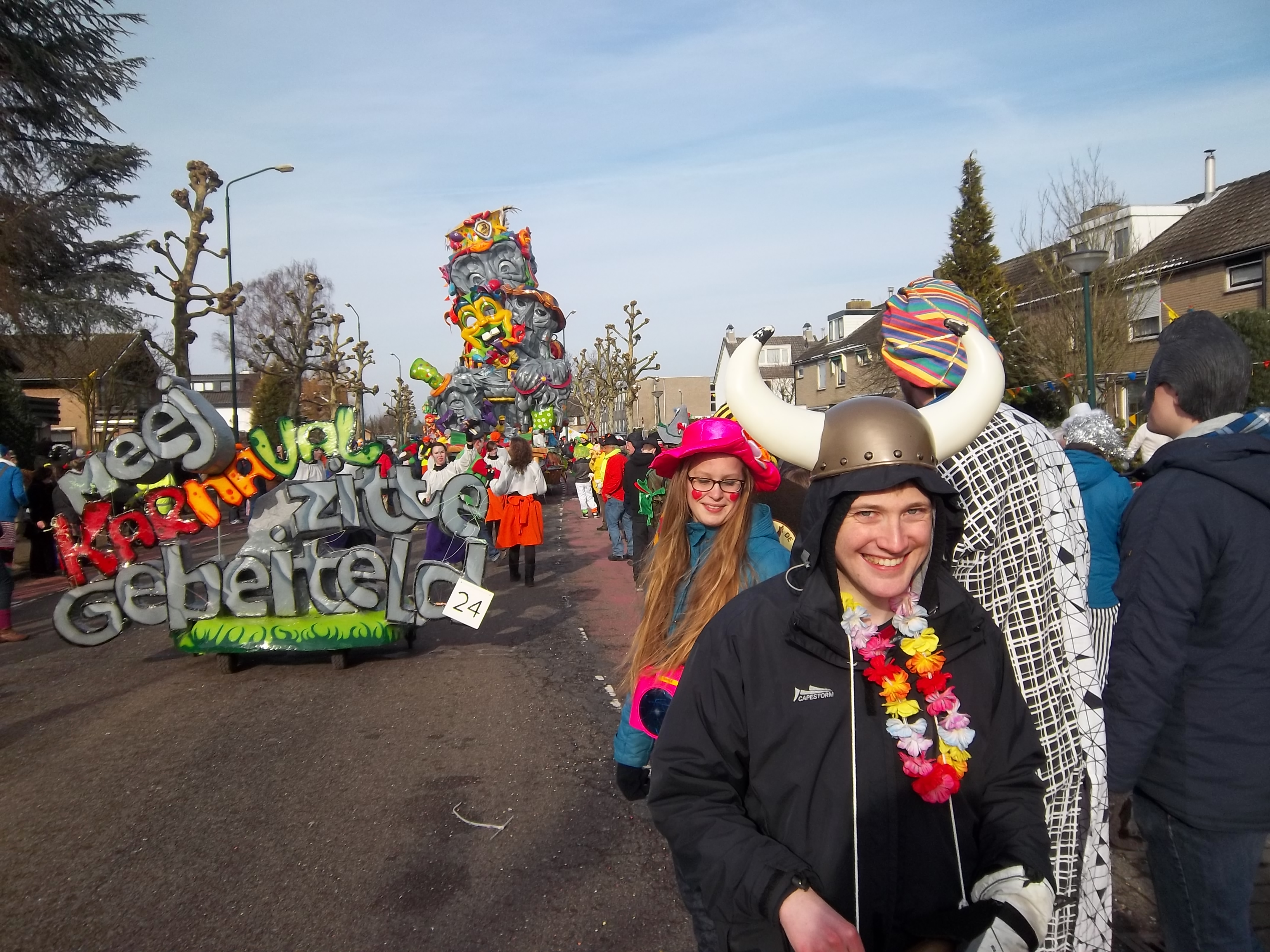


 I attended “Carnaval” this weekend, which is basically a huge party in February, celebrated in the South of the Netherlands. The South of the Netherlands is (of course) historically Catholic. Carnaval is meant to be a big party before the fasting of Lent (like Shrove Tuesday, I suppose). Of course in the Netherlands (almost) no one is religious so it is basically just a big excuse to party.
It is, however, a singular party. People dress up in insane costumes (I was a Viking with a saxophone) and there is a big parade with massive floats. My photos do not do justice to the size of these floats. Some seemed to be three stories high and they all had moving parts and blasted “foutmuziek” so my eardrums nearly burst. I awe at the amount of planning and dedication that had to go into these things.
The towns where I went get new names specially for Carnaval season, for instance Prinsenbeek, a small town near Breda, is known as “Boemeldonck”. The best parade is in Prinsenbeek rather than the larger city of Breda. Carnaval is a festival for country folk.
As with any festival, alcohol is paramount. Many of the floats were beer-themed. (Others were lewd. Some bordered on improper – for instance making fun of the church. They were all quite fun, and I do not think there was any ill intent). Many of course use the festival as an opportunity to drink more than anything else. I missed this part of Carnaval (by choice) and I instead have the memory of a fun time with some crazily dressed Dutchies.
While having fun and walking through town I did notice the remnants of the religion that this festival came out of: A Catholic church and some posters advertising the love of Jesus. Wouldn’t it be awesome if people could celebrate with love of God and with love for each other? The latter I experienced first-hand. I am most grateful for the residents of Breda and Prinsenbeek who hosted me – they were most gracious and loving. I hope that the love of God will return in time. I also hope that Carnaval retains its risqué yet fun-loving quality. It seems more sincere that way.
My cocoon of sound
I work in an open plan office. My boss sits just a few desks away in the same room. My coworkers are not particularly noisy and they’re certainly pleasant. But their very presence is a distraction.
I do not like silence. The office is silent in that there is no music, pleasant or otherwise. This already makes work less pleasant. But it is not really silent. Distracting sounds pervade the room. Innocuous banter between coworkers, discussions about work that has nothing to do with me, people walking, chairs creaking, papers rustling. Just the knowledge that when I look up, I will see seem other human being is distracting. It isn’t just that what people do that makes me less productive – it is just that they are there.
I keep feeling like, if I just go sit in my room, I’ll be able to solve whatever is puzzling me at that moment. But of course, I can’t. And my introvert batteries keep getting drained. I have found one thing that helps. Music, of course. I put on my headphones, play some classical music and it’s like a wall goes up between me and the rest of the room. I can actually focus. All those little annoying sounds fade into the background. Noisy discussions are rendered less distracting – sometimes I need to turn up the volume.
It’s like being in my own little cocoon of sound. I go home feeling less tired. If I could, I would forgo all interaction with my colleagues (except perhaps during lunch). I’d love to be somewhere on my own (preferably at home), doing everything I need to do via email, my speakers blasting Vaughn-Williams or the Star Wars OSTs.
 Meditations of Lambchop