We are all thieves: the cost of piracy
I used to download tons of movies, series and software (and occasionally games) and I convinced myself that it was not doing any harm. But it was. Piracy is a problem, both ethical and economic.
- As long as people pirate with impunity there will be pressure to enact legislation that will restrict what we can do on the internet. We saw this with SOPA, when even Wikipedia protested. However, next time such efforts may fail. I like a free internet. Piracy threatens internet freedom. This is not the fault of the multimedia companies: they have a right to seek legislation to protect their revenue.
- Freedom may also be restricted in other ways. The DRM on games has become increasingly restrictive and I refuse to buy ebooks partly because the DRM is annoying. There may come a point when movies are no longer sold on DVDs. Instead, perhaps, everything will be streamed in encrypted format using special software to make it harder to copy.
- The arms (and legal) race between product providers and piraters (which is most noticeable with games) is a cost to society.
- The makers of a product should have a right to receive revenue from the use of that product. You may argue that such revenue is unfair (for instance if the producer has monopoly power), but the solution is not to pirate. If you want a product, you should pay for it. If products are priced too highly, then this is a case for some kind of anti-trust commission or the government could consider subsidies.
- Piracy impedes the natural functioning of the economy. The more people there are who are unwilling to pay for movies and series, the harder it is to produce good quality movies and series. The industry will fail if it cannot profit. I do not know how profit figures look at the moment, but it is probably television channel subscriptions and cinemas that keep the industry going. What happens when people stop their channel subscriptions? The younger generation is far more technological and far more likely to download rather than pay. Will they change their habits when they grow up?
- It does not matter if downloading pirated media is legal in your country. The ethical and economic implications are the same.
As a Christian, I think piracy is unethical. As an economist, I think it is dangerous. Electronic media is a good with a positive externality when produced – lots of people get to use it for free. Too little is usually produced of such goods. At the moment, I think it is inertia that is keeping the system going. Perhaps soon a tipping point will be reached where there are too few people willing to pay.
I have sympathy with the fact that some people really cannot afford to buy movies or series. And renting is expensive (at least it is in the Netherlands). But the problem is, how poor is poor enough? I am by no means rich (but that depends on your perspective), but by buying second hand and old movies and some of the cheaper series, I have gotten by. First see what you can buy legally before just hitting “download”. Perhaps, if you have access to broadband internet and a computer you are rich enough.
Piracy is probably also responsible for the demise of DVD rental stores. There are few left in the Netherlands. They are probably suffering everywhere. That these stores are going out of business is not bad per sé. Schumpeter’s creative destruction says such things must happen. And replacement business models are on the rise, but they are at risk of dying in infancy.
Piracy has both highlighted and a consumer need and made it harder to profitably fulfill that need. Consumers want what they want when they want it. On demand. And they want a large selection. Pirate Bay provides this. You search for what you want. You download it. No fuss. Pay on demand services such as offered by Amazon and iTunes allow much the same thing. But they will only work if people are willing to pay rather than simply downloading. At the moment, in the Netherlands, people are not willing to pay and on-demand services are not popular.
I think perhaps the best solution is something akin to that offered by hulu.com, which allows you to stream videos for free, but with ads. They also have a subscription service with more content. Hulu is currently only available in America and Japan but I hope that it will expand to other regions as well. Hulu’s solution only works in places with high bandwidth, of course.
I understand there is certain grandeur, a nobility, to the idea that all content and information should be available freely. However, such freedom comes at a cost. I cannot comment on the intentions of creators of Pirate Bay and Napster or even Aaron Swartz. Perhaps they were noble. But the path market failure is paved with noble intentions.
(I admit I do not know all there is to know about the current market for digital media, so if I have said anything nonsensical, please leave a comment.)
Let’s not meet. I’ll email you instead.
I am definitely a candidate for a “work-from-home” job. I find that actually having to meet with people is inefficient, for several reasons. I prefer to send emails when I can.
Some of the advantages of e-mail:
- Emails are their own archiving system. I don’t have to try to remember or write down what someone was saying. I have a bad memory and a terrible short-hand. Also, writing something down means the other person needs to stop talking. I cannot listen and write simultaneously. Also, I am naturally disorganised – pieces of paper get misplaced.
- No need to find a single time slot in which you are all available. Everyone can answer and send emails at their convenience. I like to send emails when I am busy thinking about whatever it is I need to correspond about. Then I can write down what I need to say and send it off so the other person can read it whenever.
- No need to think in real time. Emails beat verbal communication because whatever you want to say can be reviewed and edited. You can take time to formulate questions and responses rather than having to go uhmm and ah and “I’ll have to think about that”. If you’re like me then you get tongue-tied when you have to think and talk at the same time. If you’re talking to your boss nervousness does not help.
- No embarrassments. I am far less likely to sound stupid in an email than in person. This is because of the things mentioned in the point above.
- No time wasted in travel. If you have to travel to a meeting, this is wasteful. Also, it takes up energy (physical energy), and emits carbon (unless you’re biking). And if you don’t have to go in to work at all, just think of all the time and energy you are saving.
- No need for irrelevancies. There are the mandatory salutations and greetings (the formality of which varies), but in general less time is spent on “how are you?” and the like and you can get straight to the point.
- No need to wait around somewhere when the person you’re meeting is late.
I even email people who are in the same room as I am because then I don’t need to go up to them and interrupt whatever it is they’re busy doing (or what I’m doing). In fact, I like it when people are not in the same room because then I have to send them an email. I admit it, I am an introvert. I avoid people.
You might think that there are things you cannot put in an email. Maybe so. But there are some innovative solutions to common problems. You might think putting maths in an email is overly time-consuming or just impossible. Not so, if you know Latex, which you must if you’re studying mathematics. I picked up the habit of typing Latex for all the maths in my emails from my maths professors. We send e-mails riddled with latex code which can easily be compiled and viewed (there are some nifty online gadgets for this – for instance here) – if needed. Most of the time the latex is perfectly understandable without compilation.
I admit sending around Latex in your emails is something only a maths student will do. But it works. And I like it. I also admit that there are a number of disadvantages to e-mail correspondence. People may reply late or not at all. Some (especially very emotional) things are harder to put into textual form. Tone is (mostly) lost. Nevertheless, for work-related things, I prefer email. For personal interaction, usually face to face is better. So, if you want to contact me, leave a comment, or send me an email.
Carnaval
Posted by johandp in Christianity, thoughts on 13/02/2013
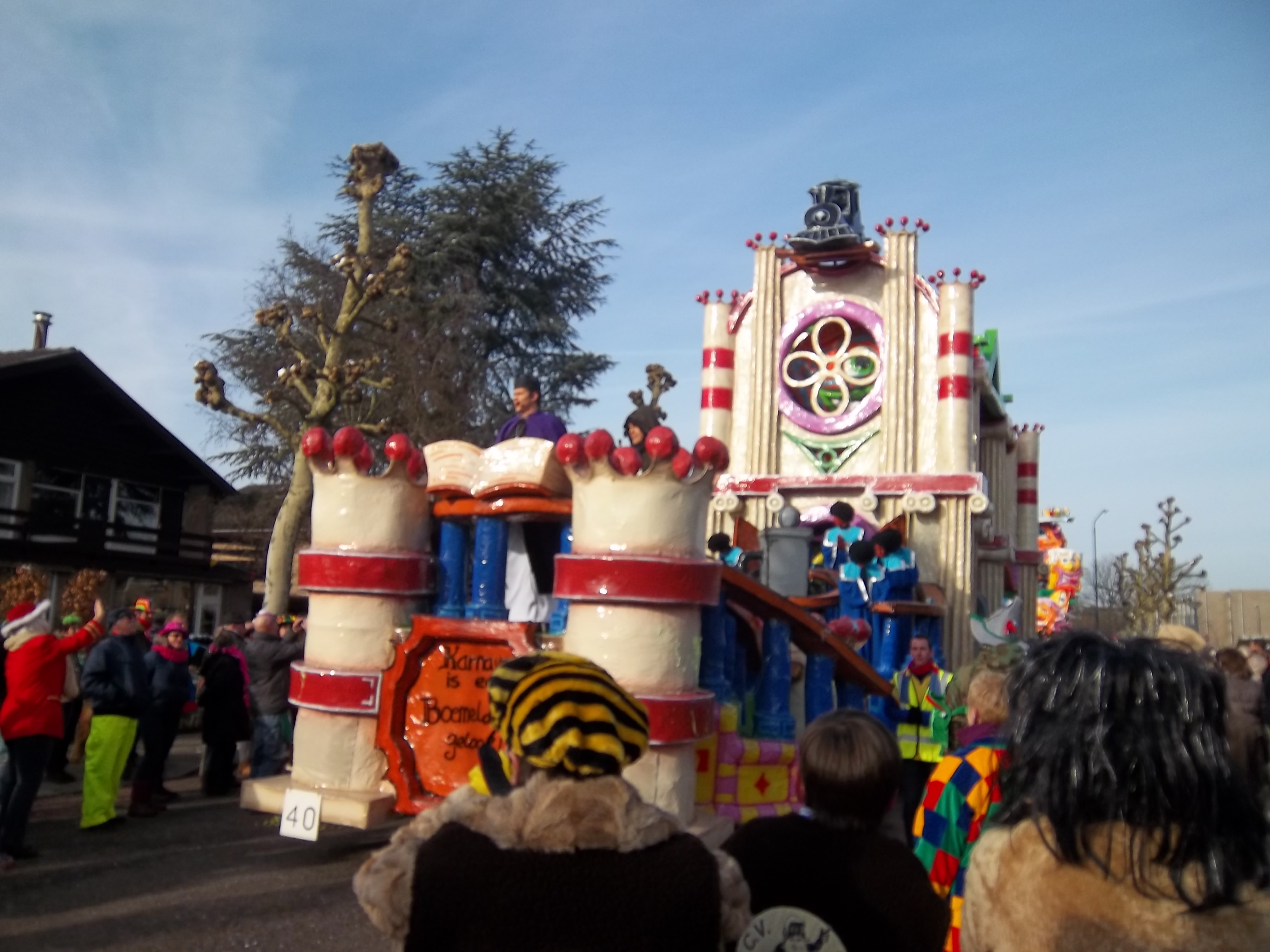

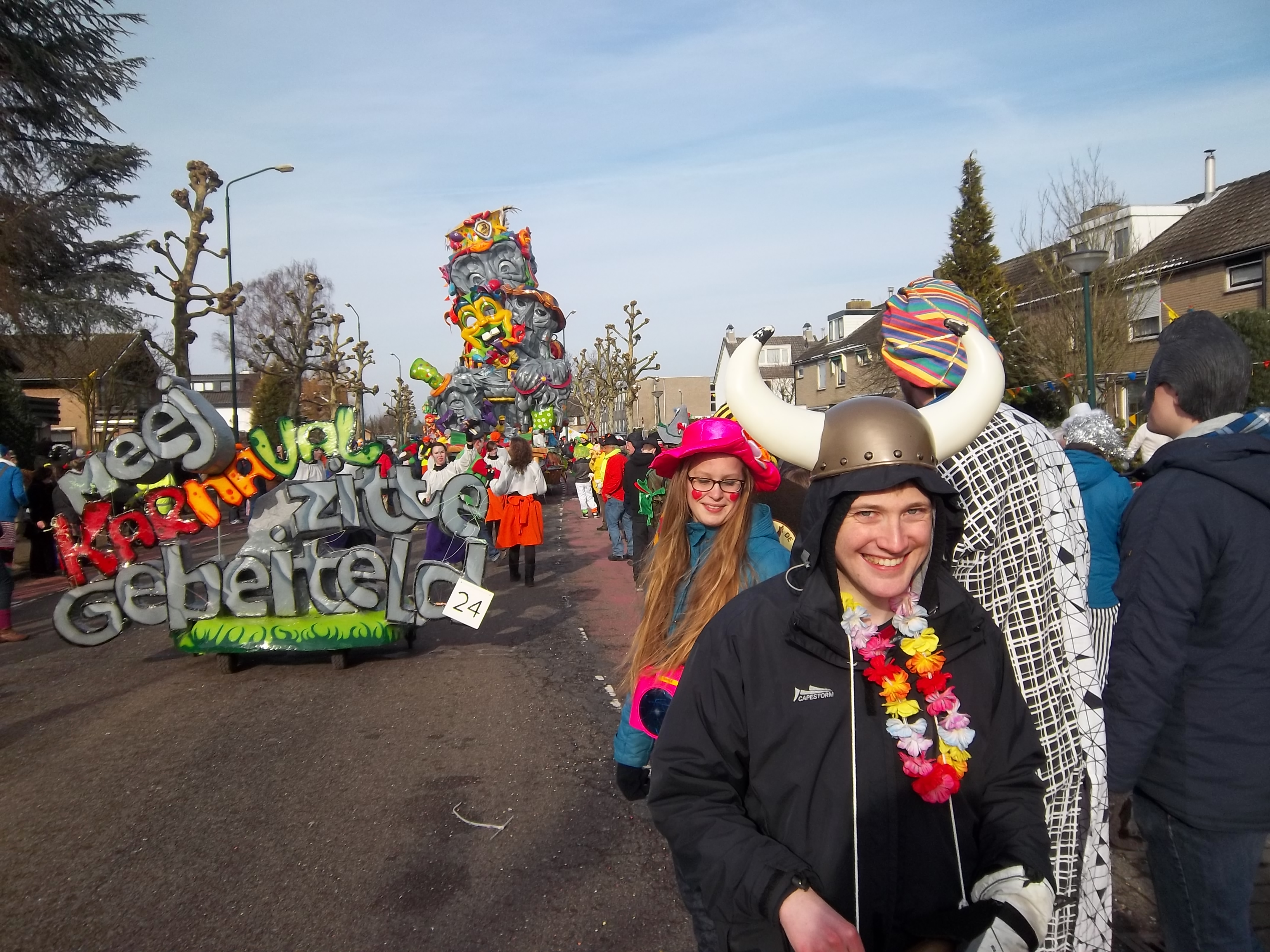


 I attended “Carnaval” this weekend, which is basically a huge party in February, celebrated in the South of the Netherlands. The South of the Netherlands is (of course) historically Catholic. Carnaval is meant to be a big party before the fasting of Lent (like Shrove Tuesday, I suppose). Of course in the Netherlands (almost) no one is religious so it is basically just a big excuse to party.
It is, however, a singular party. People dress up in insane costumes (I was a Viking with a saxophone) and there is a big parade with massive floats. My photos do not do justice to the size of these floats. Some seemed to be three stories high and they all had moving parts and blasted “foutmuziek” so my eardrums nearly burst. I awe at the amount of planning and dedication that had to go into these things.
The towns where I went get new names specially for Carnaval season, for instance Prinsenbeek, a small town near Breda, is known as “Boemeldonck”. The best parade is in Prinsenbeek rather than the larger city of Breda. Carnaval is a festival for country folk.
As with any festival, alcohol is paramount. Many of the floats were beer-themed. (Others were lewd. Some bordered on improper – for instance making fun of the church. They were all quite fun, and I do not think there was any ill intent). Many of course use the festival as an opportunity to drink more than anything else. I missed this part of Carnaval (by choice) and I instead have the memory of a fun time with some crazily dressed Dutchies.
While having fun and walking through town I did notice the remnants of the religion that this festival came out of: A Catholic church and some posters advertising the love of Jesus. Wouldn’t it be awesome if people could celebrate with love of God and with love for each other? The latter I experienced first-hand. I am most grateful for the residents of Breda and Prinsenbeek who hosted me – they were most gracious and loving. I hope that the love of God will return in time. I also hope that Carnaval retains its risqué yet fun-loving quality. It seems more sincere that way.
My cocoon of sound
I work in an open plan office. My boss sits just a few desks away in the same room. My coworkers are not particularly noisy and they’re certainly pleasant. But their very presence is a distraction.
I do not like silence. The office is silent in that there is no music, pleasant or otherwise. This already makes work less pleasant. But it is not really silent. Distracting sounds pervade the room. Innocuous banter between coworkers, discussions about work that has nothing to do with me, people walking, chairs creaking, papers rustling. Just the knowledge that when I look up, I will see seem other human being is distracting. It isn’t just that what people do that makes me less productive – it is just that they are there.
I keep feeling like, if I just go sit in my room, I’ll be able to solve whatever is puzzling me at that moment. But of course, I can’t. And my introvert batteries keep getting drained. I have found one thing that helps. Music, of course. I put on my headphones, play some classical music and it’s like a wall goes up between me and the rest of the room. I can actually focus. All those little annoying sounds fade into the background. Noisy discussions are rendered less distracting – sometimes I need to turn up the volume.
It’s like being in my own little cocoon of sound. I go home feeling less tired. If I could, I would forgo all interaction with my colleagues (except perhaps during lunch). I’d love to be somewhere on my own (preferably at home), doing everything I need to do via email, my speakers blasting Vaughn-Williams or the Star Wars OSTs.
The anonymous referee
Here is another post from my other blog, more on academia, this time peer review (don’t worry I will have some more regular meditations soon):
In academic articles, you sometimes come across a paragraph that makes no sense (even on a second or third reading). Very often you will find, attached to this paragraph, a footnote, which says something like the following…. read more
Review: Models.Behaving.Badly.
Posted by johandp in Uncategorized on 28/01/2013
Here is another post from my other blog J delta rho:
This book was written by the famous quant “Emanuel Derman”, whom I mentioned in one of my blog posts before when I commented on the Financial Modeller’s Manifesto. I was expecting a lot from this book, I admit. And I was disappointed. That is not to say that the book did not contain valuable insight…read more.
What would you pay for immortality?
Posted by johandp in Christianity, poetry, thoughts on 27/01/2013
There are people who (or claim to) have accepted their mortality. They are perfectly comfortable with the idea of dying. They may be Christians certain of their salvation or atheists certain of nothingness (which as one of my atheist friends has pointed out is not something to be feared because you won’t be around to experience it). I am not one of these people. Death – no matter where it leads – is scary and I would like to avoid it. There are people who think that we may able to do just that pretty soon, for instance Aubrey de Grey in this Ted talk.
Throughout time people have been obsessed with the idea of immortality. And it always comes at a cost.
Would you make a pact with the devil? (In the Coldfire Trilogy by C.S. Friedman the Neocount of Merentha ritually sacrifices his family to dark forces to attain immortality). Even if this were possible, I do not think I would do this. I don’t want to be evil.
Would you become a vampire? I would consider this. What would I give up: food, sun, heat, fertility. I would need to find a way to drink blood without killing anyone, of course. But all in all, it’s a bargain I could make.
Would you give up your future wages? Probably not all of your wages. But if life-extension therapies were possible, they would come at a cost. If they were privately funded, a payment of a part of one’s future wages seems likely (this could also be via a loan you take out). I would do so. My guess is, though, that should rejuvenation therapies be invented there would be a period in which only the rich can afford them – during this time the cost of the therapies would relate to willingness to pay – i.e. they would be extremely expensive because some millionaires would give up much of their wealth. But eventually the therapies would be seen as a right, and government would step in, set up some kind of insurance, probably with taxation funding everything.
Would you give up movement? What if the only way to be immortal would be to become a brain in a jar, hooked up to some computer that accepts your input? If I could be ensured of enough stimulation, I would in fact consider this, if I were near the end of my life. But think, if the stimulus were turned off, what hell would you be living?
Would you give up an organic body? Robin Hanson, an economist, thinks that we may soon be able to copy human consciousness into machines. So technically, not you, but a robot copy of you could live forever (in fact many millions of robot copies of you could live forever). Would you care about this robot-you? Would it have a soul? It would think like you, feel like you, act like you. Would it be alive?
Would you accept living in harsh conditions? I mean would you be willing to take a drastic drop in your living standard. This may be because you have to give up much of your future wages. In the world envisioned by Hanson, living standards would fall because these robots could potentially be mass-produced, drastically increasing the supply of labour. You may find yourself a miniaturised robot confined to work in a kind of farm with billions of other little robots. You may never see nature again. To live forever, I would be willing to accept rather drastic reductions in lifestyle, I think.
Would you give up your faith? Living forever does not quite fit with the Bible. Being able to copy the human conscience into machines seriously undermines faith. I think this is a bit of a reverse Pascal’s wager: if living forever being possible means there is no God, then it’s better to try to live forever. If you fail, you could still go to heaven (That is, unless God decides to punish the doubters, but I don’t think God works like that). Otherwise, you’re still alive. If you’re an atheist, this is not a problem for you. But for theists, faith may be an integral part of their lives. An immortal life without meaning – is that a life at all? Nevertheless, I would rather wrestle with the existential implications of a very long-lived life than have no life at all. I would, after-all, have a very long time to figure things out.
Would you give up those closest to you? What if your spouse felt the path to immortality was wrong, immoral, or for some reason the therapies would not work on them? Would you carry on your life alone? I think I would. Life goes on, after all.
I do not know if humans will ever be able to achieve an indefinite lifespan. I am also not particularly keen on being the first guinea pig for these therapies. However, if they become viable, and if I can afford them, I will be standing in line. I am of course just presenting just one point of view (a mostly rational one, I think). I find the religious questions raised by the possibility of immortal or artificial life interesting, but I am not about to give up Faith any time soon.
If the devil offered me forever
	I would consider
If I could pay for a drink from the water of life
	I would sell all I had
If I had to give up bread and drink your blood instead
	I could do that
If I had to live in a body of metal and circuits, without limbs
	I would, if it delayed oblivion
If I had to leave you behind, if I had to leave everyone behind
	my heart would break, but I would do it
I would take
	eternal life
	jump into the singularity
even if it cost me
	Faith and Heaven
		yes, even the reality of my soul
Humble academics
Here is an extract from the latest post on my other blog, which is about maths, probability and finance:
“I’ve been reading through (the introductions) of very many articles in finance these past two weeks. The more I read, the more I realise that in finance the truth is a very murky prospect.” Read more…
Never snow, never snow, never snow
I sometimes feel like the only person on Earth that hates snow. It is snowing outside right now, whereas my family is currently experiencing a heat wave in another part of the world. Having been through a heat wave, I can honestly say, I would rather have the heat wave.
Advantages of snow
- It is white and (somewhat) pretty – for a little while.
Disadvantages of snow
- It is cold
- It is not fun to cycle in the snow – it burns your eyes.
- It is not fun to drive in the snow (I assume)
- It is not fun to cycle or drive after it has snowed – snow that has thawed a little and frozen again is slippery and dangerous.
- It is not white and pretty for very long. Soon it becomes brown and dirty and ugly as people and cars trample through it.
- It delays all the trains (at least it does in the Netherlands where the train service are perpetually surprised when it snows in winter)
- It is cold
I omit snowmen and snowballs from this list since these involve interaction with the cold snow, which can obviously not be an advantage. Also, for those people who don’t yet know: snow is cold.

