Only in Amsterdam
I am not a photographer. However, I find myself with a few photos of things in Amsterdam that I felt like photographing at that moment. They’re not all peculiarly Amsterdammish, but I think now is the time to share them. These pictures were mostly taken in winter, so with Spring nearing (it’s still too cold to say winter is over) I feel like I should say goodbye to this winter and all the misery it caused me.
First up is a picture of a bike in a peculiar position. In a city with more bicycles than people (yes, there really are more bicycles than people) bikes get up to all kinds of naughty things. In Afrikaans we have a saying “op die paal”, but that has nothing to do with poles or bicycles.
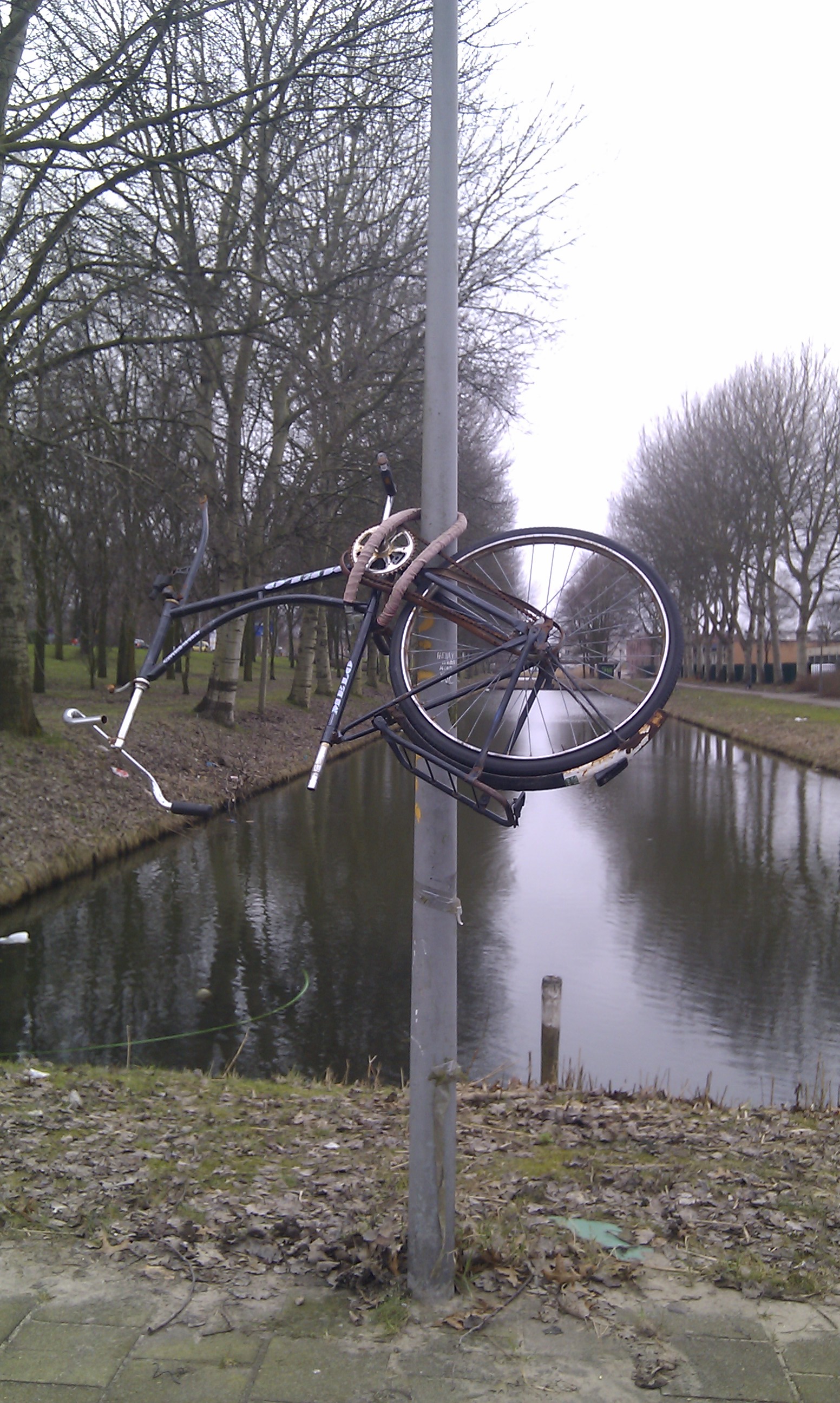
A bicycle “op die paal”
Next, bicycles covered in snow (mine is the one right in front). It snows in lots of places I know, but I come from a warm place with no snow. Snow and bicycles are an unhappy combination.
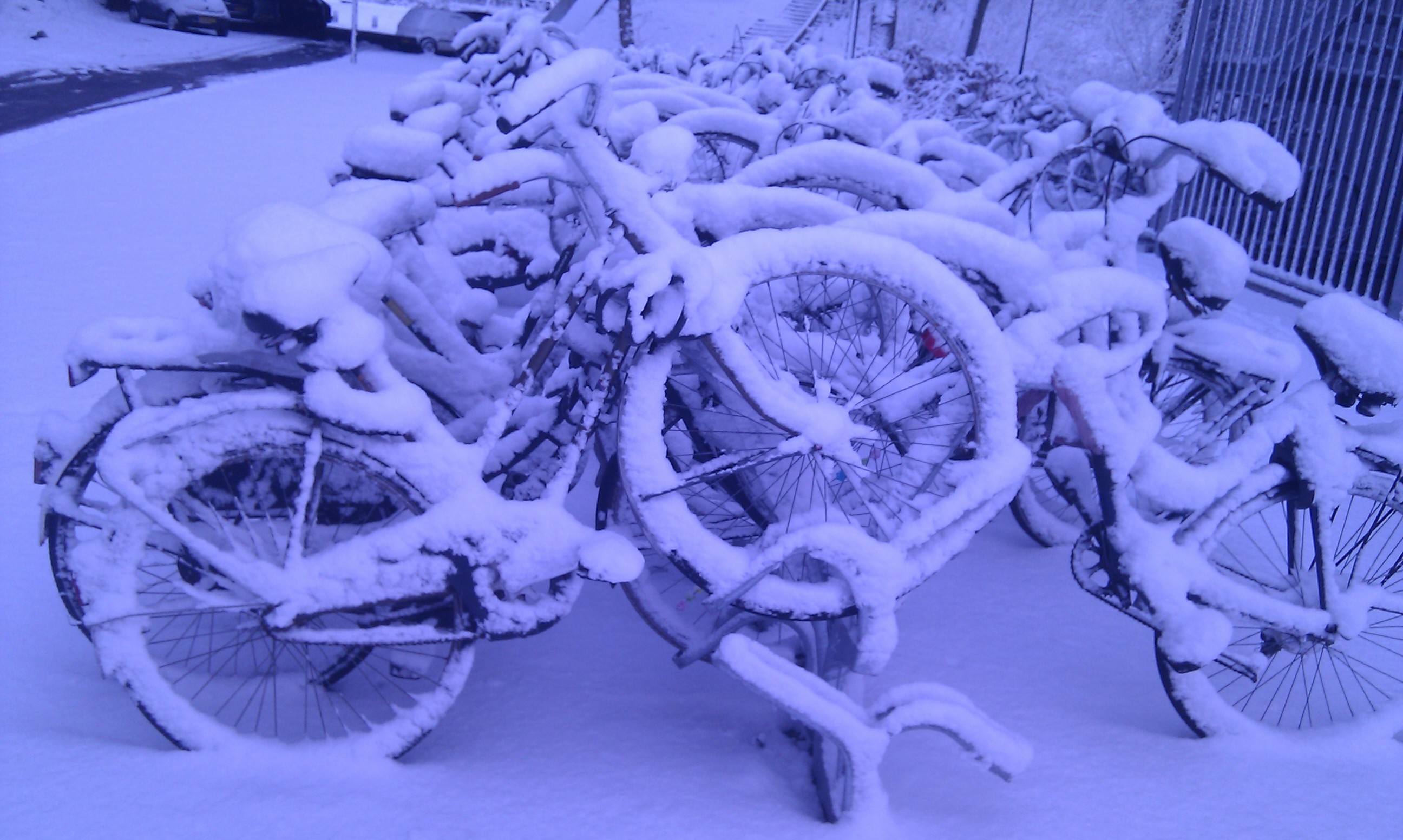
snow cycles
Some dirty brown snow. I have mentioned in a previous post that snow is rarely white and pretty for long. It becomes brown, dirty and trampled soon enough. I am not the only person who thinks snow is overrated. There is one other Dutch person who also thinks so. One person could be mistaken but two never are.

the dirty snow road
In Amsterdam there is graffiti everywhere. Not a single open space next to a train or metro track is unadorned. Here is some graffiti inside a metro which I found amusing. It’s so adorable the way they misspelt “rebel.”

adorable grafitti
A three-wheeled car like the one driven by Mr Bean’s enemy. Did you ever think you would see one of those in real life? I almost felt like doing something nasty to it. But then I thought, that would make me Mr Bean, so I just took a photo. (Actually I did not think any of this, but I did think it would sound cool if I said so).
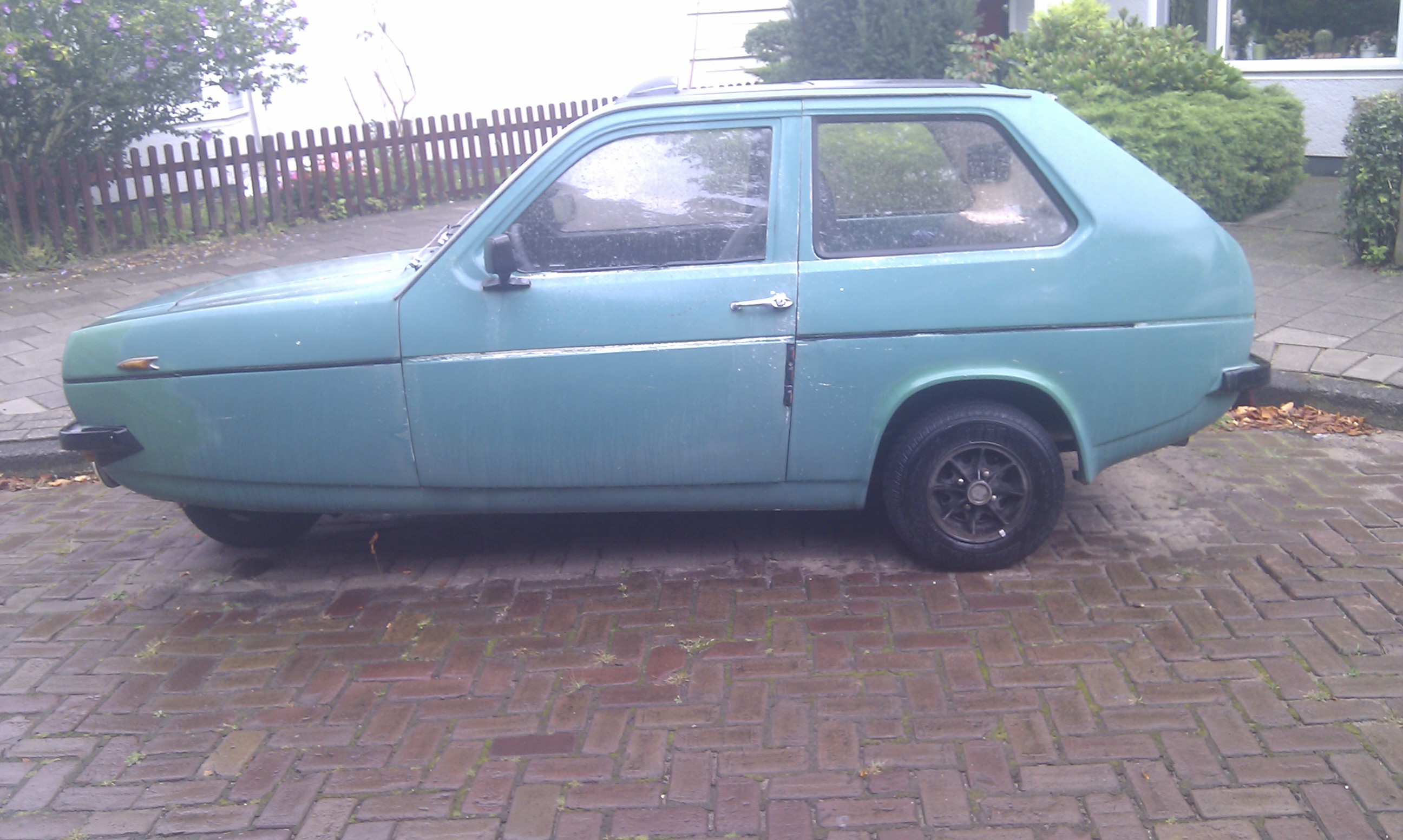
three wheeled car
A dog in a chair at Waterlooplein. Amsterdammers love their dogs. It is a cute dog.

adorable dog in a chair
Sun God
Having basically had no summer for two years, I am considering becoming a sun worshipper. It is no wonder the Egyptians worshipped a Sun god. In the Netherlands right now the Spring is cold, but sometimes the sun shines. It is a weak sun that you cannot feel through the wind and the cold air. But if you’re inside, with insulated walls and glass, the sun through your windows can be warm and, if you don’t actually go outside, you may think jackets are optional.
In a country starved for sunshine, you appreciate its power. In my case, its power to bring warmth not only to your home, but your soul.

The sun only looks bright
It is cold outside
	but here, inside
	against the glass
I feel your warmth
more real than imagined deities
	warming my soul
I press my cheek against the warmed glass
It feels like the African summer
	so far away
that I long for
Become an organ donor today
It’s Easter, a time in which we remember how Jesus gave his body for our salvation. Donating your organs when you die seems to me to be a suitable way to honour this supreme sacrifice.
I have always been in favour of organ donation, but until now nothing has gotten me to officially register as an organ donor. I just found out, however, that my mother is going to get a donor cornea, something we had been hoping for.
My family has known for a long time that I would like to be an organ donor. However, it has taken news of this good fortune for me to seek out official registration. This was rather silly of me. Registration takes 2 minutes. South Africans go to the organ donor foundation and Dutchies, you can go to the JaofNee campaign.
Register as an organ donor. It costs you nothing and it ensures that, should you die, there is no question of what to do with your body. Do it now.
Society at the end of the rainbow
Posted by johandp in Christianity, thoughts on 30/03/2013
Gay marriage is in the news again, this time because it is being debated in American courts once again. I for one cannot understand how bans on gay marriage have continued so long. In a court of law you can swear on the Bible, but you can’t use it to prove your case.
Support for Gay marriage has been rising, especially among the young. At the same time religion has been waning. There are, of course, many Christians who approve of gay marriage. There are very few, probably, who think that the issue of legality of gay marriage is entirely distinct from the issue of whether it is sinful.
I wonder what will happen. I think support for gay marriage will only grow. We are speedily heading to the end of a gay rainbow. Opponents of gay marriage are on the defensive, and that includes conservative Christians. To the “enlightened” they must seem like some cartoon villain, refusing to give up when the battle is already over. This The Oatmeal comic shows exactly what is happening.
Either the church will change to embrace gay marriage or the next generations will leave the church. Perhaps they’ll establish their own gay-friendly churches. Or perhaps Christianity will be discarded altogether.
I love the Church. I do not wish for it to be displaced. But I fear church intransigence, particularly that of the Catholic church, will drive the decline of faith in coming years. That would be alright, if it were in the name of a truly noble cause. If it were like driving money-changers from the temple. But who is the villain in this story? The myriad of gays asking for their love to be recognized?
Drawing from another Biblical reference: the writing is on the wall. The writing this week took the form of the following picture, used as a profile picture by supporters of gay marriage. It’s message is simple, appealing: Equality. It’s not going away.

The state, the church and the queers
Posted by johandp in Christianity on 24/03/2013
Homosexuality is, perhaps, the single most important issue social issue facing the modern church. How the church handles it could be its end. But the obstacles to accepting gay marriage within the church are huge and I am not sure that they are insurmountable.
Bias
I must declare a bias. I grew up in just one of a handful countries that allows gay marriage, in South Africa, just as apartheid ended. My mind is coloured by the ideals of equality and freedom that the South African constitution upholds. As such, the idea of placing homosexual relationships on an equal footing with heterosexual ones seems natural to me. It is my default position. But it is based on culture more than theology.
I also suffer (as most humans do) from a confirmation bias – I easily dismiss anything that does not agree with my chosen conclusion. When I read this article about gay marriage being accepted in Sweden (the article itself is probably far from unbiased) I got a warm fuzzy feeling[1]. And when I watched this excellent BBC miniseries with two female lovers in the 19th century I rooted for the socially unacceptable couple.
But if you’re a Christian then you must think about homosexuality and gay marriage Biblically, at least in the context of the church. The church cannot make decisions based on culture alone.
Why gay marriage should be legal
I would like to give a somewhat different perspective on the gay marriage debate. I think gay marriage should be legalised – this is not to say that gay marriage is “right” (from a Biblical perspective), but rather that it is not something the state should care about. This is similar to the way I argued about abortion (of course, I am not trying to equate the act of getting married to abortion).
Take the Bible out of the equation for a second. When you are talking about the State then you must do this. The state must be secular. By secular I do not mean “atheistic”. I mean that the state must be independent of any particular faith (or unbelief). All the arguments against gay marriage are based on religion and thus no longer count.
There does not seem to me to be any intrinsic difference between a heterosexual and homosexual union that should bias the state against the latter. Unless, of course, the state needs somehow to promote childbearing (but that could be better achieved by banning contraception) and with many alternative ways for homosexual couples to obtain children (sperm donors, surrogate mothers, adoption) this may be a nonissue anyway.
Homosexuality and Christianity
I confess, I would very much like for homosexuality to be compatible with Christianity. I want to see gay couples getting married in churches. I think this would be very good for the church (provided it is theologically justifiable). It would eliminate one of the greatest sources of criticism of the modern church. It would bring thousands upon thousands of gay men and women into the fold, people who currently feel rejected and marginalised. There would be love and acceptance rather than stern condemnation or even loving disapproval.
This is utopian. There are far too many Christians who believe that homosexuality is a sin for the Swedish situation (if it has not been exaggerated) to be replicated worldwide. And there is too little Biblical evidence to convince these people they are wrong. I cannot convince myself they are wrong, though I so dearly wish that they are.
If you look at the Bible you will see:
- At best the Bible is silent about Gay marriage
- If not silent, it has nothing positive to say about it.
- At worst, it condemns it.
For the people who are sure that the last point is the truth, I would remind you of one thing: God loves everyone. He loves sinners. Even if homosexuality is a sin (and I am not saying it is), it does not and never will negate salvation. A believer is saved. Period.
(Of course, if you have a well-substantiated opinion on homosexuality and gay marriage I would love to hear it. Please leave a comment.)
[1] Aside: it seems to have become fashionable to depict homosexual causes with lesbian couples. As a man I don’t mind this, but let us not be misled by pictures that do not affect us, or by pictures that do.
Marriage: the scariest, most beautiful thing
I’m getting to that age, that age where your friends start pairing off into couples and becoming married. Do not worry, this post is not about how mortified I am that I am still single and how there’s no end in sight. Instead I want to say something about the incredible commitment that marriage is.
I can think of nothing more beautiful and more terrifying than marriage. If you’re a Christian, then, in theory at least, marriage is for life. The certainty you must have to make that commitment… I think I might have to wait till I’m a hundred before I am that certain about anything (except death and taxes).
Marriages do not always last. When you enter into one, you must (even if you are a Christian) be aware that it may end prematurely. That does not mean you should not try. And marriages that do not end in divorce, end in death. There must be no greater grief (except the loss of a child) than the loss of your life partner. If you’re a woman that is most likely what you will experience (women live longer and marry younger), but men are not exempt of course.
Still, a life shared is a beautiful thing. I am thinking beyond the wedding and the honeymoon. It is in every day’s living, in the little joys, in the dull, the dreary, in toil, strife and hardship, that a marriage is built. It is in saying “I love you” every day, to mean it even if you’re in the middle of a heated argument.
Marriage is not a cure for a lonely life. It does not make a broken person complete. But it does, sometimes, make of two people, a single being, inseparable, a force of joy and love and an inspiration to all. It is truly a gift from God (one that like a plant must be nurtured if it is to last). I hope that all my friends who are married and soon to be married (and those who will marry later) experience this gift.
I wrote this poem for you:
Love is grand – it deserves a festival
and a honeymoon
and a yearly anniversary
romantic dinners and flowers and gifts
perfume and makeup

Love starts with a beating heart
and sweaty palms
with grandiose gestures
but it is in everyday things
that love is made complete
in two lives that become
in  every day’s living
a life shared
in little joys
in leaving for work
in weekday dinners
in the love (or hate) of football
in the dull, the dreary
in shopping
in the choice of asymmetric carpets and paint
in toil, strife and hardship
in paying the bills
together

Love is quiet and unrelenting
its strength is the strength of God
its weakness is the weakness of man
love matures with its hosts
becomes the finer for their wrinkles
and frailty

Love is a gift from God
Don’t trust research, not even your own
The more research I do (and I have not done much) the less I trust other research, and the less I trust my own. When you read a paper in finance you will invariably find significant results that support the author’s conclusions. When I run regressions, my results are weak, sometimes contradicting my hypothesis sometimes confirming it.
Read more of this post on my other blog, J delta rho, here….
Dutch Capitalism – not always very capitalistic
A Chinese colleague of mine once claimed that Maoism (a form of communism) is better implemented in the Netherlands than China. I don’t know enough about Maoism to be able to argue for or against this, but sometimes the Dutch system of capitalism is very anti-capitalistic. Take, for instance, a practice known as “koopzondagen”.
These are Sundays on which shops open for business. Until recently I just thought shops chose to be closed on Sundays, except for the koopzondagen. In Amsterdam this appears to be the case. But it is not so in the rest of the country. Local governments (or municipalities – I am not sure which) have the power to regulate whether shops can open on Sundays or not. Thus it is that in Tilburg there have been shops opening on Sundays despite this not being allowed (after some debate it has been decided to allow them to open).
I could hardly believe it when I heard this. Why would you not allow shops to open on Sundays? If you are of certain (dogmatic) religious bent you could argue that it respects the Sabbath. But Dutch people are not. Perhaps it is a legacy of the Dutch religious past that they have not done away with yet.
A country that values the freedoms of its people and its economy (as the Dutch do) cannot allow such a nonsensical system to continue. There are many consumers that would like to shop on Sundays, many shops that would like the freedom to open on Sundays and many people willing to work on Sundays. Everybody benefits. Many shops may choose to stay closed on Sundays and this is fine. But it should be their choice.
The right to beg: a third world perspective
(Disclaimer: this was written based entirely on my own personal experience. If I have any facts wrong, please let me know. )
I recently read in a Dutch newspaper that there are 253 registered beggars in Amsterdam. Several things about this statement shocked me.
253 is ridiculously little. I don’t think any city in South Africa has so few beggars, even as a percentage of population (though I have not checked the figures –there may not even be any figures).
The fact that beggars are registered and that begging is in fact outlawed (except, I suppose for these registered beggars) seems almost monstrous when you come from a country where almost every traffic light in every major city has children below the age of ten asking you for some coins. To deny so many people this form of income because it is a nuisance is something I cannot even countenance.
There are too many beggars to register in South Africa and there are certainly too many people who live off begging in order to make it illegal (that said, I have not checked our laws, but I have never heard of anyone being arrested for begging). There are the children that I have mentioned, but many grown men and women too, mostly black. Increasingly, you also find white people with cardboard placards asking for help because they have no job. I make this distinction between South Africa is still a very polarised country. The white are rich, and except for a handful of elites, the black are poor.
Of course, there are naturally people who take chances, who essentially con others via begging. (I have been conned into giving money to someone who supposedly needed it to catch a bus or a train, only to spot them in an another location not long afterward asking for the same thing.) One can argue that those children on SA street corners are being misused. They often are, I think. The Netherlands has the luxury to control its beggar population. South Africa does not. It is an administrative and man-power intensive task that our government and police force cannot handle. Nor is it one they should handle. There are far more important things to do.
Ideally, I think, all “charitable” money would be channelled via organisations that could oversee the use of that money. I don’t know the state of the NGO space in South Africa, but I suspect it can’t solve all the problems. And a request for a donation from an NGO will never be quite as persuasive as a cupped hand in your face.
In a country as divided as South Africa perhaps the rich need permanent reminders of their good fortune. Perhaps all it leads to is a habit of apathy. But one can be held accountable for apathy, not ignorance. I would like to see a day where South Africa is no longer has beggars, where it can have the luxury of outlawing such distasteful things. I do not think I will live long enough (and I plan to live a very very long time).
I have often been one of those apathetic rich people (rich compared to most South Africans, that is). This little article in a Dutch newspaper has made me question my actions, and, importantly, my inaction.
I am reminded of a quote by Henry Ford:
Capital punishment is as fundamentally wrong as a cure for crime as charity is wrong as a cure for poverty.
I don’t believe that giving to beggars solves the problem of poverty. (It’s an easy way to salve your conscience, perhaps). But when you walk past that beggar, when you turn that blind eye, it is an opportunity to evaluate your life, to ask yourself, have you contributed to a world in which begging would no longer be necessary? For me, the answer, too often is an accusatory “no.”
The God in our language
Posted by johandp in Christianity, thoughts on 27/02/2013
Do you listen to the things you say? I listen to what people say and their words do not always reflect their beliefs. Atheists call upon God and Christians who otherwise profess things to be the will of God blame things on luck or coincidence when it is convenient.
Admittedly, it’s often hardly their fault. Our language has evolved this way. It’s hard to make utterances completely congruent with your beliefs – in fact people might think you’re a little strange. If your friend is about to write a big exam, do you say
a) Good luck,
b) May the will of God let you succeed, or
c) Your hard work will pay off
Everyone says a) at least some of the time, even if their beliefs are more consistent with b) or c). “Good luck” is just something one says. In some sense it’s lost its meaning. No one thinks they can control whimsical chance. If you’re a Christian, perhaps the best thing to say is “God speed”, which literally means “let God prosper you”, but this now has connotations of impending doom (thanks, probably, to movies and the US military) and so your friend may lose heart entirely.
When you narrowly avoid disaster, do you say
a) Thank God,
b) Thank goodness,
c) I was lucky, or
d) It was God’s will
At different points you may find yourself saying more one of the above. Even Atheists like to say
“Thank God” and they don’t seem to see the irony. I think you should only thank God if you really mean to thank God. But then, should we avoid thanking goodness? I think the world is random (designed that way) and so I see no problem in blaming things on luck – as long as by luck you mean probability or chance.
When something upsets you, do you say
a) f***
b) Jesus Christ
c) Mary mother of God
d) Darn
e) Shit
I say “flip”. It’s less coarse than any of the above, but its purpose is pretty much the same: A thoughtless word expressed in anger. Why do we want to be profane when things go wrong? Perhaps we want blame the God whose name we invoke, even if we foreswear His existence. Perhaps we want to punish the universe for our predicament (as if it cares). Perhaps we don’t think at all.
There is a particular usage of words that some Christians like and which I avoid. They may say things such as
a) I felt God say to me…
b) The spirit moved me…
c) I had a calling…
d) I just felt something…
d) is probably the most honest. There is probably nothing wrong with a) to c), but unless you make it clear that you’re just interpreting your circumstances, your thoughts, your dreams, or your feelings, you can mislead people.
When someone sneezes, do you say “bless you?”
Are lovers fated to be together?
When you meet someone in an unexpected place, is it a coincidence?
Is getting that promotion an answer to your prayers or did you deserve it?
Is it a miracle or an as yet unexplained mystery?
Our language betrays us. In some sense, as Christians, God is alive in our language, in how we interpret the world. A cynic might say God only exists in our language. When I say something is a miracle, I acknowledge God’s power over reality. But does that mean I should pepper my language with references to God? If God wills I will go to such and such a place and make money…
I think we should practice make our language consistent with what we really mean in every circumstance. Atheists should not thank God. If I think something is a coincidence or just pure luck I shall call it that. Leave it to someone else to say it is the will of God, if that is what they mean.

