Self-critique
Here is an extract from a post on my blog J delta rho about the importance of being self-critical in academia. This is, of course, also important in life. It is not enough for others to acknowledge your faults, you must acknowledge them for yourself and actively seek them out.
I recently finished my masters thesis and I would now like to do something that most people never do. I am going to critique my work. I believe that being self-critical is essential not only in research, but in life in general. In research it is necessary to further the truth. It is not enough that others are critical of you (though it is necessary). You must be critical of yourself – only then will you be willing to remedy your flaws, change your convictions and pursue truth and goodness rather than your own prejudiced agenda.
Read more of this post on my other blog, J delta rho, here….
Some (not so) humble poetry
Ironic self-aggrandisement is a peculiar form of humour. I use it all the time, but it may be quite irritating to tell everyone how wonderful you are, even if you do so in an ironic tone, because, just maybe, a little part of you believes what you say.
By rights the world should worship me
I saved it just the other day
but of course I’m too humble to admit it
I’m actually a very charming person
but I’m afraid my charm only works
on intelligent people
I have many good characteristics
a razor-sharp wit, for one
and I’m really good in the sack
when I rule the world
you can be in my harem
you should be honoured
many other people will die
everyone should just do what I say
the world would be a better place
why not go into politics?
no, no, politics is for people
with superiority complexes
I’ll make you my queen
you could rule the world
with an iron hand
or the household at least
I’ll rule the world
god and I are buddies
he asks Me for advice sometimes
the rain of fire that destroyed the world
my idea, or was that the previous world?
The laws of biking in Amsterdam
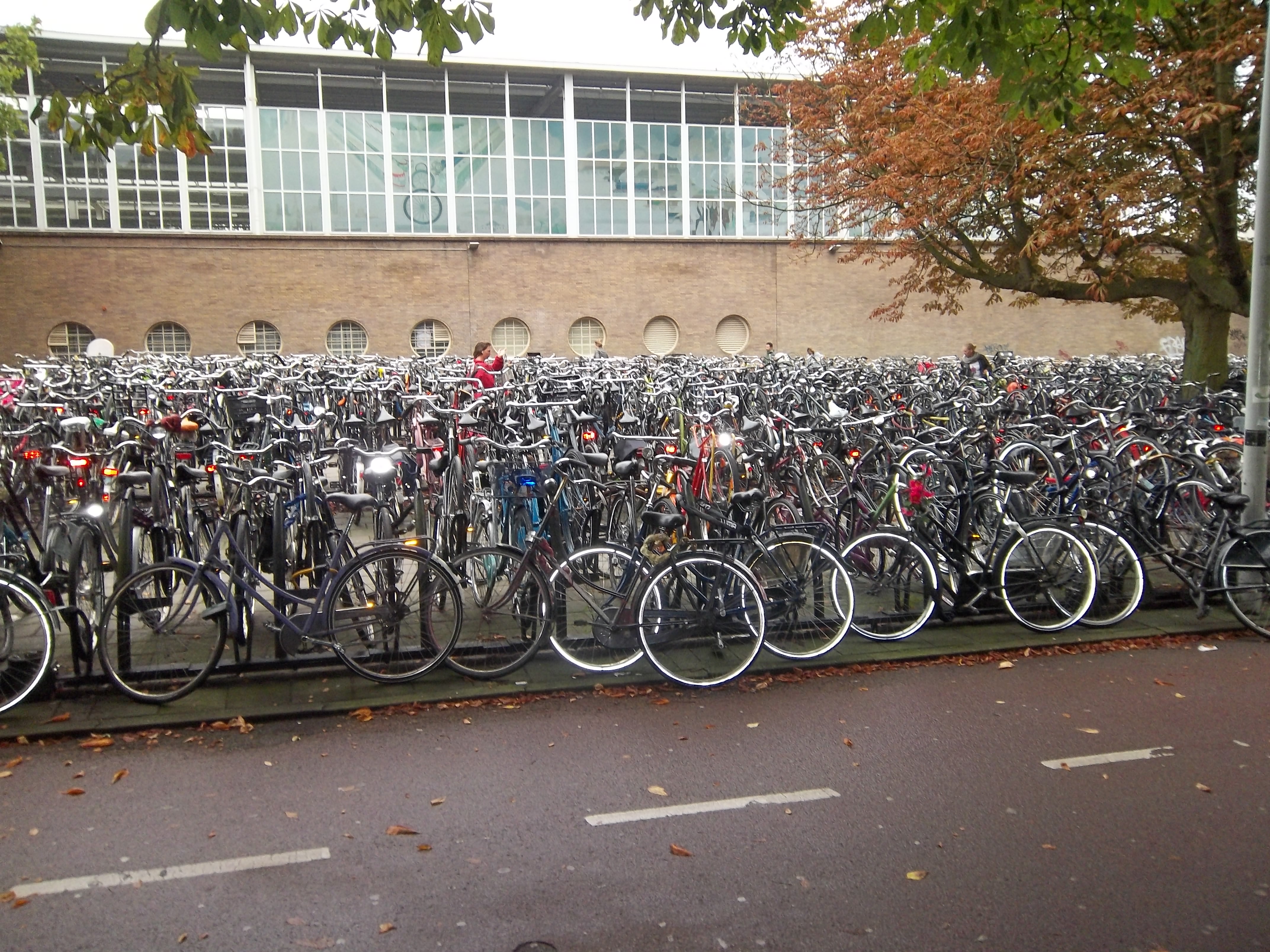
This is not even a lot of bikes
If you live in Amsterdam, you will get to know the laws of biking. Ignore these laws at your peril. If you think you will not cycle in Amsterdam (I did) you are wrong. You will cycle, and you will like it, and you will complain whenever you are forced to use public transport because it is expensive and slow. Biking is awesome (except when the weather is really horrible, for instance when it snows, and even then “real” Amsterdammers will bike) and good for you and the environment. You are not really an Amsterdammer before you regularly go around on your bike.
The laws of biking in Amsterdam
- You will bike in Amsterdam.
- Murphy’s law of biking: The wind is always against you.
- Corollary to law 2: The wind will be against you no matter which way you turn.
- Trams are designed to lure unsuspecting bikers onto their tracks, and then tram-ple them.
- Red lights do not apply to Dutch cyclists.
- Foreigners who think law 5 also applies to them may get tram-pled.
- Your bike will get stolen.
- Corollary to law 7: an expensive lock is better than an expensive bike.
- You will lose the keys to your bike lock and have to cut it off.
- You will forget where you left your bike, among thousands of other bikes in the area.
- Take OV (public transport) and be late. Take the bike and be on time.
Race and education
My alma mater, the University of Cape Town (UCT) has been in a (seemingly endless, but necessary) debate regarding race-based admissions. Currently it gives preference to black students. That the debate has gone on so long shows just how important the symbolism of race is in South African politics.
The alternative to race-based admission is to use things such as how highly educated a student’s parents are, the quality of the school they attended, and income. Ultimately I do not think this will not markedly affect the pool of people eligible for admission and who get given preference. Black students are the most likely to meet these criteria.
But it changes the symbolism of the process completely. It no longer assumes every black kid is previously disadvantaged (there is a new generation of young blacks whose parents are middle-class and this middle class is growing rapidly) and that every white kid is previously advantaged. Coloureds, who have complained that they are underrepresented in “transformation” may now stand an equal chance. It levels the playing field and I think it has to be done. It is a symbolic step in the direction of a South Africa in which all men (and women) are equal without sacrificing the need to redress the social injustices of the past.
I have stated in previous blog posts my natural aversion to affirmative action. I have, however, no aversion to university admissions policies that take into account more than just the grades of an applicant. Many students with a lot of potential have grades lists that look terrible merely because they had a substandard education for instance. Brazil found with its affirmative action candidates (here the policy also appears to be race-based), called cotistas, that they did not fare much worse than the other students, and in fact caught up quite quickly. This was for two reasons: they worked harder and they had a greater ability than show by their entrance grades because they were not coached for the entrance exams. We want such students in our universities.
Apparently affirmative action was also quite successful in American universities and this has been stated as a reason for continuing race-based admission. That is a fair point, but the redress of social disadvantage is inherently ideological and it seems to me that using clearer indicators of disadvantage fits better ideologically and is likely to give the same (or even a better) result. I do not know if there is research on this. If there is not, then I think we should try it.
I have no idea if South African affirmative action candidates fare well at university. (If you know, please leave a comment). I do know that it is unfair to keep them out. But I think it is counterproductive to force the demographics of the university to reflect the demographics of the country one for one. Find the students with ability, take into account their background (not their race), and give them the opportunity they deserve. The demographic change will come.
South Africa’s attitude problem
I have always said that South Africa needs effective education in order to escape its poverty trap. There is, however, something else that is perhaps even more important and far harder to obtain, a change in culture or attitude.
If you look at the unrest, the constant strikes (often accompanied with violence), the unceasing corruption, you get the impression that there is a culture of entitlement. “We were harmed by the legacy of Apartheid and therefore we deserve [insert demands here]”. I fear this is only hampering our progress.
If we are to grow, to escape the bonds of apartheid, we need people who not only demand opportunities but create those opportunities. We need people willing to work to create their futures rather than just demanding it from the government or their employer. This is a part of the problem that I have with affirmative action. It enforces the entitlement culture. It says “you deserve the opportunity and we don’t care what you do with it.”
With youth unemployment in South Africa over 50% there is another negative effect on attitudes: despair and hopelessness. The belief that there is no way to improve your circumstances can lead to two things: complete inaction or unbelievable anger. We probably have both in South Africa, but it is the latter that makes news headlines.
Thus we need firstly to give people hope. Hope is the motivation. Then we need to make sure they know that their lives are in their hands – it is their responsibility to improve their lot. But how do we do that? Perhaps the answer still lies in our education system, in perhaps the most influential role models besides parents that children ever encounter, in teachers
We live in Elysium
It occurred to me after seeing the trailer for Elysium, the new film by the director of District 9, that real life is perhaps not so very different from the situation described there. District 9 portrayed South Africa past. Elysium portrays the world as it is now.
The setting is so ridiculous, so Sci-Fi that it doesn’t immediately register. But the premise is essentially that the divide between rich and poor is enormous and unfair and that the poor are being hindered from advancing.
I know little of immigration laws, but it seems to me that it is quite hard to move from one impoverished country to another more prosperous one. And even then it is hard to be treated on equal terms with the rest of the country’s inhabitants. Much harder still (practically impossible in fact) is breaking out of the poverty of generations of inadequate education, which you will inevitably pass on to your children.
In the Elysium trailer there is some machine that removes minor ailments. It seems unbelievable that those in Elysium should have access to this, but the people on Earth are dying (presumably in pollution, with lack of food, medical treatment, etc.). If you are a middle-class South African or a resident of a first world country, you might not realise how ridiculously unequal the real world actually is. I had my teeth straightened with braces at a great cost to my medical aid when I was in my teens. It now seems to me almost monstrous to have been able to get such a cosmetic procedure when in my own country there are people with no access to clean water. How different is this from the futuristic machine in Elysium?
Of course, I think this is the point the movie is trying to make. We live in a world divided. If you get born into the right home in the right country or the right area you grow up with privilege. But a very large portion of this world is denied even the most basic human needs. We may not have separated ourselves from these people with as much clarity as putting ourselves in a space station, but we are separated from them nonetheless. A part of this separation is geographical (country and neighbourhood), a part of it is in structures (barb-wire fences around our homes), but mostly it is in our minds. We do not just absolve ourselves of guilt: we hardly recognise the need to do so.
I am not going to advocate giving away masses of wealth to the poor or to the poorest nations. Charity is not the solution. But I think we need to recognise we do not live in a cosy world and we need to figure out what to do about that. I hardly have any answers.
By the power vested in me by the State, the Church and Facebook….
Some of my friends have gotten married recently. And soon after (within hours) they changed their relationship status on Facebook. It’s almost like with dating, it’s not really official until it’s “Facebook official.” Facebook seems even to have changed the way we get married and how we announce it to the world. No longer in the newspaper, but in a relationship status.
Perhaps weddings should start including a relationship status ceremony in which the couples change their relationship status (perhaps there are people who have already done so). I can just imagine the minister saying something like “By the power vested in me by the state, the Church and Facebook, I pronounce you ‘married’. You may now change your relationship status.”
There is nothing wrong with the effect of Facebook on marriage. It’s efficient and adds another social dimension, the online dimension, to marriage celebrations. But, as I recently reminded a newlywed, when you’ve gotten married you should go on your honeymoon and leave Facebook alone.
The abuse of Mandela’s legacy
Sometimes I think there is only one thing that all politicians in South Africa agree on: the semi-divinity of Nelson Mandela. He and possibly Desmond Tutu (who headed up the Truth and Reconciliation Commission) are perhaps the only ANC political figure whose records are not plagued by rumours of corruption, incompetence or ignorance.
I do not believe Mandela is a saint. Mandela headed up the ANC for five years after our first free and fair elections and he was the symbol of peace that kept blood from being spilt. Yet the party under him has never experienced a moment without accusations of corruption. I sometimes wonder if he could have done more to make the ANC the political party that South Africa deserves.
Now he is an old, ailing man and it is too late. Rather, his legacy is being abused. Firstly, by his own party who can pretty much count on the people’s votes as long as they are Mandela’s party and then do whatever they like. Secondly, it seems by his own family, who appear to be making a lot of money from his legacy (that said, much of this money may well be quite legal, if not necessarily tastefully acquired). Many more, for good or for ill, invoke the spirit of Mandela. He is a sort of deity: his blessing whether real or implied can make an endeavour succeed.
The SABC (a public broadcaster, i.e. politically influenced) released footage of Mandela after he had been in hospital for some time. In what seems like an almost unbelievable feat of cognitive dissonance, Jacob Zuma and others proclaim Mandela’s health while Mandela himself seems apathetic and, frankly, nearing death. I have no idea what the ANC was trying to achieve, but it seems to me they only managed to enforce the idea that Mandela and his legacy are nothing more but pawns for their games.
Mandela was and is, I believe, loyal to the ANC. He would not turn his back on his party. But his party has abused his loyalty. And they will continue to do so after he is gone. Mandela’s legacy will live on when he dies, in fact, it is likely to become even stronger. And with death he will truly seem Saint-like. Mandela’s legacy is for everyone. Like Ghandi his words and actions transcend time and circumstance and politics. It is a powerful thing.
I wish the power of this legacy may be free from political abuse, but until the ANC is dissolved, I fear this will never truly be the case.
Black diamond power
[I must apologise for not blogging in some time. Life caught up with me.]
I read a very interesting statistic this week. The black middle class in SA, known as ‘Black Diamonds’ has outgrown the white middle-class in numbers and spending power.
The 4 million black diamonds in South Africa are still only a small portion of the black population. But their presence represents a huge change. They have the power to change, not instantly, what has always been a white English (and to some extent Afrikaans) dominated culture and economy into one for blacks. However, the culture of the black diamonds has probably become more westernized than anything else. They will change things, but it will suit their culture, a new urban black culture.
I wonder where these black diamonds come from. 20% of them are in civil service, the product of a large government. This is not where we want them to come from. A large number are probably the products of Black Economic Empowerment, a system that I have never been fond of.
However, this must be said. These black diamonds are leaving behind a new generation of educated blacks – their children. They have created a foothold for black people in the South African economy. It’s a foothold only for a small number of people. Their presence has exacerbated rather than lessened income inequality in South Africa. They have entered the domain of white prosperity rather than bringing that prosperity to South Africa. But if they spread their wealth and their influence beyond their immediate families – in the way that Africans are apt to do – they could reach a far greater number of black people. If the presence of these black diamonds could help black children outside their immediate families to obtain better education or training that could make a difference.
Of course in much the same way BEE gave opportunities to blacks instead of “more deserving” whites, these black diamonds could do the same for their friends and family. This would not be so great for the economy and brings a number of other problems. But it does accentuate the trickle-down process I described.
People will help their own. Place black people in a position to be able to substantially help their own and they will. This is perhaps the one success of BEE. But I wonder if it is enough. A small black foothold we have. But no matter what we do in the short term it is going to take a massive country-wide improvement in access to education to bring the prosperity we need.
Why Americans should stop playing football and other “hard” decisions
I do not see the world as made up of simple cause-effect relationships. Instead I see an intricate web of interrelationships that my mind cannot un-entangle. I cannot focus on any single aspect without losing something of vital importance. This makes it hard to make decisions. But sometimes, I think, this is really just an excuse.
Fair Trade
Think of Fair Trade products for instance. Do they actually work? They act somewhat like a minimum wage, which with classical economic models increase unemployment and reduce welfare. However, minimum wages have been shown to work in practice. And there is something rotten about just allowing people to work in intolerable work conditions. Unfortunately, there seems to be very little academic evidence of the efficacy (or non-efficacy) of Fair Trade. It is reasonably clear, I think, that at least the people who do work for Fair Trade suppliers are better off.
I have for long been skeptical about Fair Trade and I still am. Economics has proven time and again that the only thing you can really count on is that your actions will have unintended consequences. However, how much proof do you require before you change your actions? When are you using the need for proof merely as an excuse not to act?
Black lung disease and football
This need for proof is what Malcolm Gladwell addresses in this speech at Penn University. He firstly recalls how America took 50 years to start reducing the exposure of miners to coal dust, despite there having been reasonable statistical (but not quite irrefutable) evidence to conclude that coal dust was causing black lung disease. He then does something audacious. He says the university should disband its football programme. There is a condition, known as CTE, that appears to be caused by repeated blows to the head and has been found in the autopsies of many football players.
American universities will never stop their football programmes. It is too important to them to even consider. But they are not alone. We take too long to react because we cannot accept things that will inconvenience us.
Global warming
Another issue that of global warming. There is certainly a lot of evidence that we have been heating up our planet. But the evidence is mixed. (In fact, it appears global warming is happening more slowly than expected). The climate is a hugely complicated system. Saying anything with any degree of certainty is hard and it takes time. Unfortunately we cannot wait until the ramifications of global warming play out. There is a large group of people that need more evidence to change the way they live their lives. It is easy to use the absence of “absolute” proof as an excuse not to do anything.
Of course, sometimes what seems like a good does turn out to be a bad idea. Take “local food” for instance, which is the idea that buying food produced in your area (not imported from thousands of kilometres away) is better for the environment. All else equal this is true. However, transport is only part of the carbon emissions from food production. Buying locally produced meat and eggs may in fact be worse for the environment if these are produced in an “organic” way, which it turns out releases more greenhouse gases (I get this from Wikipedia, so feel free to correct me if you know of better research) .
Long live the animals
This raises another point : the issue of animal welfare. If free range and organic animal products are worse for the environment, and you care about animals, then you should consider becoming a vegetarian. I love meat, though, and so this would not be something I would consider (perhaps I am not all that different from those coal mining companies). But it does seem like a good reason to decrease my meat consumption.
In the final analysis
The world is hideously complex. The choices we make today may or may not fulfill the good intentions we had when we made them. But too many people wait for too long before they act. You must ask yourself, whether your need for proof is in the best interests of the world you are living in. This is certainly something I need to consider.

